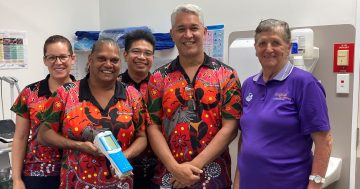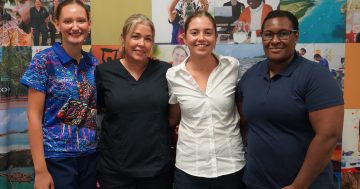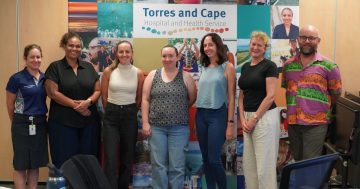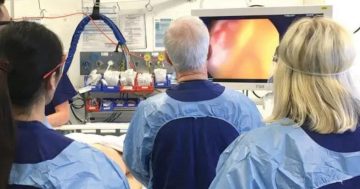
Research on two rare diseases affecting First Nations people in Far North Queensland is getting $9.3 million in funding after an initial $25,000 investment produced critical early evidence. Photo: Far North Queensland Hospital Foundation.
A $25,000 investment in research on two rare genetic diseases affecting First Nations people in Far North Queensland has helped secure a further $9.3 million in national research funding.
The initial Far North Queensland Hospital Foundation (FNQPH) grant aided researchers in gathering critical early data on Machado‐Joseph disease (MJD) and spinocerebellar ataxia type 7 (SCA7) in Aboriginal people — something that was previously poorly understood.
These inherited conditions cause progressive incoordination, imbalance and visual impairment, leading to loss of mobility, speech and swallow, and ultimately, early death.
In 2024, the foundation’s seed funding enabled the establishment of regular clinics in Cairns and Townsville, providing local patients with reliable access to specialist care, and enabling the collection of foundational clinical, neurophysiological, and oculomotor data.
Clinics in Cairns identified a further 20 patients, including those from Weipa and Napranum, with the team monitoring a further 10 people and identifying another 416 at risk of MJD or SCA7.
Foundation grant recipient, University of Melbourne Head of NeuroMovement Disease Laboratory, Associate Professor David Szmulewicz, said the funding generated the first detailed descriptions of how MJD and SCA7 presented in these communities.
“Although gene therapies are on their way, unfortunately, at this stage, these diseases can’t be cured, but once we identify patients, we can start treatment,” he said.
“Of course, as with any medical condition, the more research we can do, the more hope we can offer people for the future.
“Importantly, these early clinical insights and locally‐run clinics became the evidence base required to attract major national funding.”
Building on the data found, Associate Professor Szmulewicz and collaborators have been awarded $9.3 million over five years from three institutions: $3.15 million from the Medical Research Future Fund (MRFF), $1.2 million to investigate spinocerebellar ataxias in Indigenous Australians from the National Health and Medical Research Council, and $4.95 million from the MRFF for delivering benefit for all Australians in the new era of complete genomics.