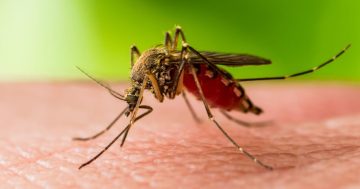
Six Asian tiger mosquitoes were found at Bamaga on Cape York last month, and spraying continues to ensure the invasive insect doesn’t spread across the mainland. Photo: James Gathany/CDC.
Spraying continues across northern Cape York to prevent the spread of the world’s most invasive mosquito after half-a-dozen of the insects were discovered during routine surveillance activities in May.
Northern Peninsula Area Regional Council advised on Thursday (16 July) that Queensland Health was continuing its mosquito spraying program at Bamaga and keeping a a close eye out for more Asian tiger mosquitoes.
The mosquitoes have spread across the Torres Strait over the past two decades, but are not usually found on the Australian mainland. They aggressively bite humans (leading to the nickname ‘barbecue stopper’) and spread diseases such as dengue fever, zika virus, chikungunya and yellow fever.
The council said spraying in the Northern Peninsula Area (NPA) would continue until 12 August and focus on the Bamaga area.
Torres and Cape Hospital and Health Service has confirmed the six Asian tiger mosquitoes caught about two months ago had “no signs of carrying any tropical diseases”.
“To ensure effectiveness of this program the NPARC regulatory team will be assisting the mozzie team with the precautionary spraying activities during 21 July to 12 August 2026,” the council states.
Spraying areas that harbour mosquitoes including vegetation will occur in Bamaga from 21-29 July, while mosquito sweep-net surveys will be undertaken across the entire NPA in the same timeframe.
Yard-to-yard larval sampling and treatment will also be carried out in Bamaga from 4-12 August.
The council has asked the community to help them access properties to eradicate any mosquitoes. Dogs should be restrained and yards should be safe to enter.
Residents have been urged to cover up exposed skin when outside in the garden and to empty any water containers where the insects could live and breed. Wearing light-coloured clothing and using insect repellents and screens can also help.
Meanwhile, the national science agency has partnered with British biotechnology company Oxitec Ltd to “develop an Asian tiger mosquito solution to protect Australian communities from this deadly threat”.
The CSIRO’s “highly targeted, non-toxic, insecticide-free, and environmentally sustainable method” involves reducing the female mosquito’s ability to reproduce.
“Only female mosquitoes bite and are capable of transmitting disease. So, reducing the female’s ability to successfully reproduce is the key to controlling Asian tiger mosquito populations,” researchers state.
“We aim to do that by creating a safe, effective and self-limiting strain of male Asian tiger mosquito that – when it mates with wild Asian tiger mosquito females – produces non-biting, non-disease transmitting males. A self-limiting gene prevents female offspring from surviving long enough to reproduce.
“Regular releases of these males into a wild population would prevent the production of wild female mosquitoes, resulting in suppression of the target population by greater than 90 per cent.”

Queensland Health has confirmed the insects found at Bamaga were not carrying diseases. Photo: Cape York Weekly.
The CSIRO has assured the public it operates under strict guidelines and regulations around gene technology research and the solution would be safe for humans, animals, crops, and the environment.
This is because the genes are only passed on for a few generations and stopping releases of self-limiting males would result in the wild mosquito population returning to normal in about 10 weeks.
The insects would also carry a fluorescent marker gene to allow scientists to distinguish the self-limiting insects from their invasive counterparts. This improves efficiency and simplifies monitoring.
Asian tiger mosquitoes are most likely to enter the mainland as eggs or larvae in cargo which can hold water, including tyres, machinery, bulk steel and yachts. The eggs are also regularly found on imported lucky bamboo.
Suspected sightings of the mosquitoes – which are about four millimetres in length, black and white in colour with a distinctive white stripe down the centre of its back – can be reported to the Department of Agriculture Fisheries and Forestry on 1800 798 636.