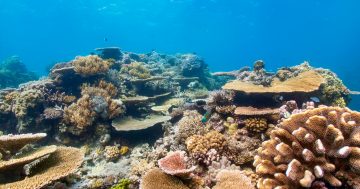
The research could help safeguard the Great Barrier Reef – and other reefs worldwide. Photo: James Cook University.
Researchers digging deeper into Great Barrier Reef bleaching have found sustained winter heat causes coral to suffer more damage during subsequent summer months.
Moderate winter temperatures may prime the coral to reduce bleaching impacts, according to James Cook University (JCU).
The research tested how winters influence coral sensitivity to bleaching – either readying the invertebrates to cope with heat stress or leaving them more vulnerable in the summer.
JCU student Valerie Cornet, who led the study, said: “Most bleaching prediction tools focus on summer heat and assume that corals start each summer in the same condition.”
“We wanted to see how cooler seasons, particularly winter, influence bleaching in the following summer,” she said.
The team analysed bleaching observations from in the water and air, as well as sea surface temperatures across the central reef from Townsville to Port Douglas, focusing on the 2016/17 bleaching seasons.
JCU professor and study supervisor Scott Heron, said 2016 and 2017 were the first consecutive years of severe bleaching on the reef.
“The scale and severity of these mass bleaching events were unprecedented, affecting vast areas of the reef,” he said.
“This gave us a rare opportunity to study how repeated heat stress and recovery periods interacted, including effects before summer conditions set in.”
Prof Heron said there was a “Goldilocks range” for coral – “not too hot, not too cold, it’s just right”.

JCU Professor Scott Heron supervised the study. Photo: James Cook University.
“We think that corals living in these conditions might be better prepared for a stressful summer because they are exposed to a little bit of prior heat,” he said.
Ms Cornet said moderate winter heat could stimulate coral to produce heat-shock proteins, boost cellular repair, increase metabolic activity and shift symbiotic algae to types with better heat resistance.
“Sustained winter heat can deplete energy reserves, damage tissues and weaken this symbiosis, making corals more vulnerable,” she said.
It’s hoped the results can help improve early-warning systems and predictive models.
“Incorporating winter conditions into forecasting tools can help managers better anticipate when and where severe bleaching is likely to occur,” Ms Cornet said.
“If we know that certain reefs have experienced unfavourable pre-summer conditions, they may be at higher risk during the next heatwave and could be prioritised for monitoring, protection or local stress-reduction measures.”
Prof Heron said the findings were applicable beyond the Great Barrier Reef.
“The influence of non-stressful, moderate winters on the impacts of summertime stress is vital to all Australian and international reefs,” he said.
“But we must remember that while these findings can improve our predictive skills, that does not reduce the urgency of reducing greenhouse gas emissions that cause ocean warming.
“Over a billion people rely on coral reefs for their daily livelihoods. This research isn’t just about science — it’s about people, both here in Queensland and around the world.”