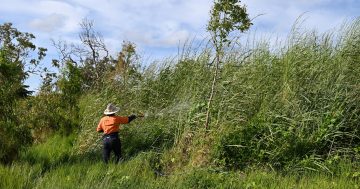
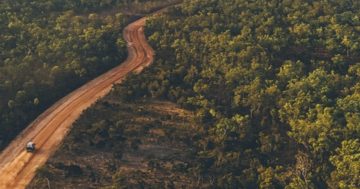
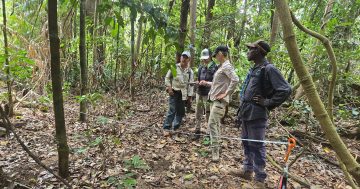
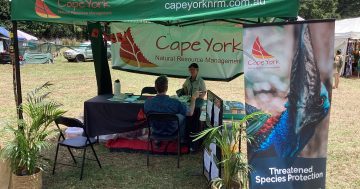
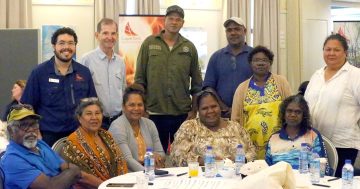
Work is underway to clear thousands of hectares of invasive gamba grass across Cape York. Photo: Cape York NRM.
Thousands of hectares of land is being cleared of highly invasive gamba grass in Cape York, helping prevent the notorious weed from spreading more extensively throughout Far North Queensland.
Major infestations of the weed have been reported along roads as Cape York Natural Resource Management (NRM) plans to start mapping the problem.
Gamba grass infests about 60,000 hectares of northern Queensland and the Cape and Atherton Tablelands are the worst affected areas.
Isolated infestations have impacted the Gulf of Carpentaria region, Townsville region and as far south as Proserpine, according to the Queensland Department of Primary Industries.
Listed as a weed of national significance, the plant’s seeds are carried by the wind, water and attach to mud stuck to vehicles and machinery.
The tall weed forms dense tussocks which choke off nutrients and water to native vegetation, reduce tree cover and help fuel late-season fires.
Native to Africa’s tropical and subtropical savannas, gamba grass was imported into Queensland for livestock grazing in 1942 and planted more widely from the early 1980s.

Gamba grass. Photo: Cape York NRM.
Cape York NRM is working to tackle gamba grass over about 20,000 hectares of wetlands and native vegetation by 2028 through the Cape York Wetlands and Native Vegetation Resilience project.
The project which began late last year includes Indigenous Land & Sea Ranger groups, Aboriginal corporations and land trusts, graziers, local councils, Parks and Wildlife, Biosecurity Queensland, South Endeavour Trust and the North Australian Indigenous Land and Sea Management Alliance. More partners are due to join the project.

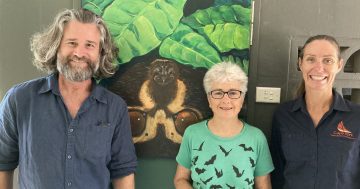
Cape York NRM project lead of biodiversity and threat management Maree Coulson. Photo: Cape York NRM.
Cape York NRM project lead of biodiversity and threat management Maree Coulson said the weed was a serious problem, but it was not too late to make a difference.
“It was introduced regionally as a pasture grass, but now it’s actually taken over significant areas of native vegetation,” she said.
“There’s some really major spreads along the larger road corridors, but it is manageable at this stage.
“It’s (the project) going really well. We have done a lot of planning and there’s been a lot of work to get the project where it is at the moment, but it’s really exciting.”
Ms Coulson said it was important to get the community involved along the way.
“We’ve got very complex land tenures up in Cape York. We’ve got various different stakeholders. A lot of national parks, but also a lot of the nature refuges and also the grazing properties,” she said.
“You can’t do this without community.”
Ms Coulson said “we love working with our landholders and our Cape York community” and it was satisfying to see the progress made.
“At the moment one of the focuses of the program is working with the Cooktown (Shire Council) Gamba Grass Taskforce, who will work with a lot of landholders in and around the eastern Cooktown region to tackle spreads of gamba on their properties,” she said.

Gamba grass. Photo: Cape York NRM.
“We’re looking at doing a bit of mapping as well to get more of a detailed understanding of the spread of gamba across the Cape.”
Gamba grass can be identified by its V-shaped fluffy seed head and thick stems covered in fine white hair. The weed grows up to four metres tall and often towers over native grasses, remaining green and upright when other grasses dry out and collapse.
Anyone who spots infestations should contact their local council or Biosecurity Queensland.
The project is funded by Queensland Government’s Natural Resource Management Expansion Program.