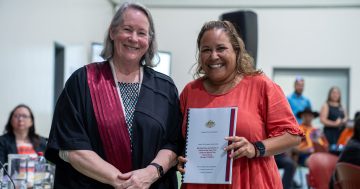
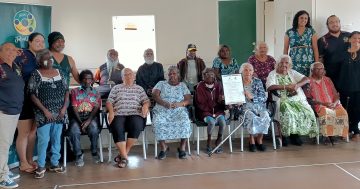
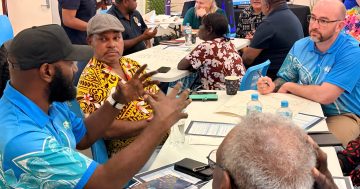
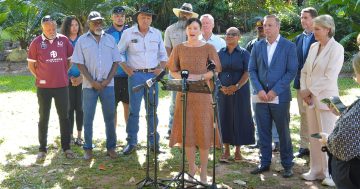
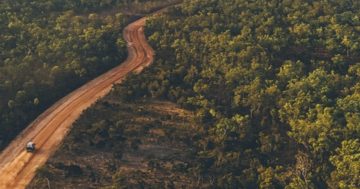
Attendees at the Western Yalanji native title determination at Cairns on Friday. Photos: Cape York Land Council.
Cape York traditional owners are celebrating two historic native title rights determinations covering almost 4000 square kilometres of land in total.
The Federal Court formally recognised the Eastern Kuku Yalanji people’s claim for 217,884 hectares on the peninsula during a hearing at Wujal Wujal last Wednesday (12 August).
A separate native title determination for the Western Yalanji people over 170,827 ha was held at Cairns Convention Centre on Friday.
The Western Yalanji determination was the 34th under the Cape York United #1 claim, which is 91 per cent complete and one of the largest native title campaigns in Australian history, according to the Cape York Land Council (CYLC).
Iconic locations which are part of the significant determinations include Cape Tribulation and Black Mountain.
On Friday, Chief Justice Debra Mortimer apologised for the drawn-out Western Yalanji determination process.
”You have waited a long time for these determinations and I thank you for your patience with the system of native title,” she said.
”It has been slow and it has been complicated and I am sorry that it has taken so long.
“But what is happening today is that your property rights under your traditional law are being recognised, and they are rights against the whole world.”
Mr Ah Mat said traditional owners had maintained connections to Country under traditional laws and customs, despite dispossession and generations of exclusion.
The Cape York United #1 claim was filed in late 2014, when about 45 per cent of Cape York had been resolved under native title claims, following about 23 determinations dating back to 1997.

Western Yalanji elder Cedric Gore says the determination means “there will always be a place for us”.
CYLC chair Clara Day said: “The Cape York United #1 Claim aimed to achieve in five years what had taken 20. It has taken more than 10 years, but we are now at the finish line.
“The families of Cape York have fulfilled the vision of Cape York elders and family leaders, who came together at Lockhart River in 1990 to establish the Cape York Land Council and begin the long work of securing the return and recognition of their lands,” she said.
“Today’s determination is a tribute to those elders. They wanted their children and grandchildren to have the security of knowing where they belong, the authority to speak for their Country, and the opportunity to protect it and build a future on it.”
Western Yalanji elder Cedric Gore said the determination meant there was certainty families would always have a place on Country.
“Now that we have native title recognition, we know that wherever we go there will always be a place for us,” he said.
“When I go out on Country, I feel good. I’m excited for the celebration and the dancing. It’s a big celebration after a long time.”
Elder Rose Snider said the determination was about returning to the land with family and passing knowledge to children.
“It means having ownership of where we belong,” she said.
“The good part is it’s time to go back to Country with family and give my knowledge to the kids, how to hunt and fish, and sharing those things with our neighbours. To go back home.”

Western Yalanji elder Rose Snider says the decision means more say over what happens to Country.
Western Yalanji man Bruce Meldrum said the determination would help the community care for sacred places and waterways.
“With this recognition of our Country, we get more say over what happens,” he said.
“It means we can protect Country and our waterways more. Water is sacred to us; we use it as part of the healing process, to hunt and to fish.”
Western Yalanji woman Susan Baru was looking forward to taking the youth to traditional lands and said she’d “love to get them out there working on Country”.
Western Yalanji Aboriginal Corporation RNTBC will continue as body corporate for the area.

Western Yalanji woman Susan Baru says she’d love to get more of the youth working on the land following the determination.
The determination involved agreements between state and federal governments, Cook Shire Council, pastoralists, mining interests and telecommunications providers. It recognises exclusive native title rights over some areas and non-exclusive native title across most of the determination area, the CYLC added.