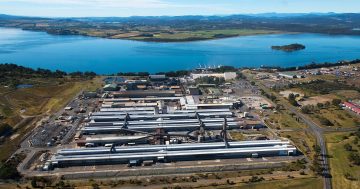
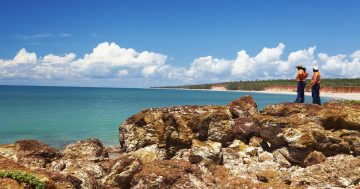
Rio Tinto bauxite mining operations at Weipa. Photo: Rio Tinto.
Weipa is set to benefit from a huge public funding injection aimed at keeping the nation’s second largest aluminium smelter up and running.
On Wednesday morning (25 March), the Commonwealth and Queensland governments, alongside Rio Tinto, announced $2 billion in a landmark partnership to lock in the future of Boyne Smelter near Gladstone and transform the state’s energy grid.
It’s been described as one of the most significant industrial investment and decarbonisation commitments in Australian history.
Rio Tinto’s bauxite operations at Weipa supply raw material to the Central Queensland smelter and provide work for more than 1300 people.
Jobs at Weipa and Gladstone will be protected thanks to the deal, according to a joint government statement.
The resources giant states the $2bn deal ensures the smelter will remain internationally cost-competitive. It builds on power purchase agreements signed in recent years to underwrite $7.5 billion in new renewable energy and storage in Queensland.

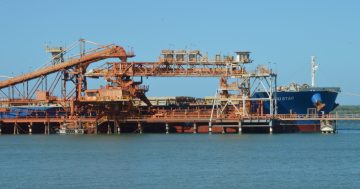
The governments and Rio Tinto say jobs will be protected thanks to the funding. Photo: Rio Tinto.
The governments will invest the $2 billion over 10 years to 2040, finalising terms of a partnership between Queensland and Rio Tinto, and forming part of the Commonwealth’s Future Made in Australia initiative.
Boyne Smelters Limited, which Rio Tinto has a majority stake in, is due to continue producing aluminium “through to at least 2040”.
Jerome Pecresse, Rio Tinto aluminium and lithium chief executive, said the “transformative partnership” would “ensure Boyne Smelter remains internationally competitive, strengthens the Australian aluminium sector for the future and supports the transformation and decarbonisation of the Queensland energy system”.
“As fossil fuels become increasingly expensive, this investment, combined with the power purchase agreements we have already signed, positions Boyne to be among the world’s first aluminium smelters underpinned by solar and wind power,” he said.
“It also ensures heavy manufacturing like aluminium smelting can continue in Gladstone for the long term and preserves one of the few fully integrated aluminium value chains in the world – from bauxite mining to alumina refining to aluminium smelting all in Queensland — as demand for aluminium continues to grow with the energy transition.”

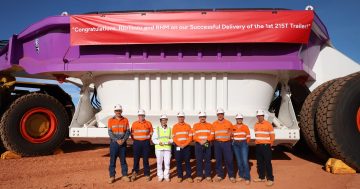
More than 1300 people work for Rio Tinto at Weipa. Photo: Rio Tinto.
Minister for Natural Resources and Mines, Minister for Manufacturing Dale Last — also the Minister for Regional and Rural Development — said: “At a time when supply chain disruptions are being felt across the globe, this investment is needed now more than ever to safeguard Queensland’s sovereign manufacturing capabilities and to build national resilience and international competitiveness.”
“Only in Queensland can we mine, refine and smelt to produce one of the world’s most versatile and ubiquitous metals, being aluminium, and we must protect that capability,” he said.
“The Crisafulli Government’s Energy Roadmap is delivering a plan for Queensland’s energy future — this announcement backs in the thousands of Queensland workers that rely on smelter and gives industry the certainty it needs to invest in the region.”
Minister for Industry, Innovation and Minister for Science Tim Ayres said it was “a good day for Queensland jobs, a good day for Australian industry, and a step toward an economy where no one is held back and no one is left behind”.
He said governments were “stepping up to partner with industry and unlock the enormous industrial potential of our regions”.

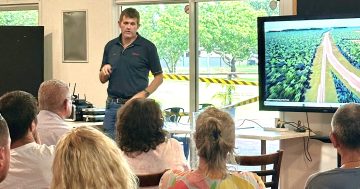
Mapoon Mayor Ronaldo Guivarra has welcomed the announcement. Photo: Supplied.
Mapoon Aboriginal Shire Council Mayor Ronaldo Guivarra said the announcement “is great news for Mapoon” and the community “drives the machinery which supplies the smelter, our community oversees safety and makes sure operations work”.
“Securing the future of the smelter has a flow-on benefit for the entire state,” he said.
“Aluminium is in our every day and the key mineral to produce it comes from the western Cape; supporting onshore smelting means jobs across Queensland.
“The strength of Australian aluminium comes from the long history of the western Cape, our history, our communities, and our culture continues to drive the growth of this industry.”