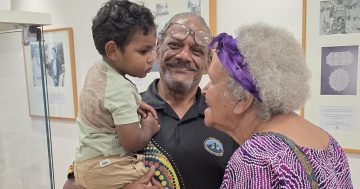
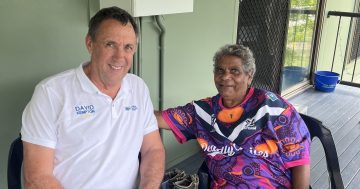
Wuthathi Aboriginal Corporation RNTBC Chair Keron Murray and Wuthathi Tribal Elders Council Chair Johnson Chippendale celebrate a historical return to Country after their ancestors were forcibly removed more than 100 years ago. Photo: Christine Howes.
More than 250 Wuthathi people have gathered on their ancestral Country in Far North Queensland, many visiting the land for the first time since their families were forcibly removed more than a century ago.
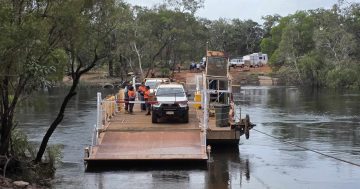
Families from Lockhart River, the Northern Peninsula Area, Cairns, Townsville and beyond travelled to the remote Cape York site on 22 September for a day of traditional dancing, feasting and reconnecting with Country.
More than 100 campsites were established for the gathering, which Wuthathi leaders described as a major milestone in a generations-long struggle to return to and protect their homeland.
Wuthathi Aboriginal Corporation RNTBC (Registered Native Title Body Corporate) Chair Keron Murray said the gathering fulfilled a vision held by generations of Wuthathi elders.
“Today is a day that our old people dreamed about,” he said to families on the day.
“A day that generations of Wuthathi people fought for.
“And today, we are standing here, on our Country.”
Following their removal in the early 1900s, efforts to return began in the 1950s and continued through the decades, with the planting of the Aboriginal flag on Country in the 1980s marking an important moment in the community’s efforts to reconnect with its homeland.
Wuthathi Tribal Elders Council Chair Johnson Chippendale said work with anthropologists helped document sacred sites and traditional place names.
“That was recognised by the state — that’s Wuthathi Country, these people are from there, and that’s how it started,” he said.
“It was very hard for our people to get back on Country.
“Today, we are celebrating our success, our strength, our survival as Wuthathi people.”
Mr Murray said securing Country had required the community to build governance structures and develop systems that worked across Indigenous and non-Indigenous contexts, adding that the return to Country was not the end of the work.
“Getting Country back is not the end of the fight. It is the beginning of our responsibility,” he said.
“We want our children, and their children, and their children’s children, to have jobs, education and opportunity.
“We want a strong Wuthathi economy.”